
Paediatric Orthopaedics
Specialised care for musculoskeletal disorders, growth abnormalities, and bone injuries in infants, children, and adolescents.
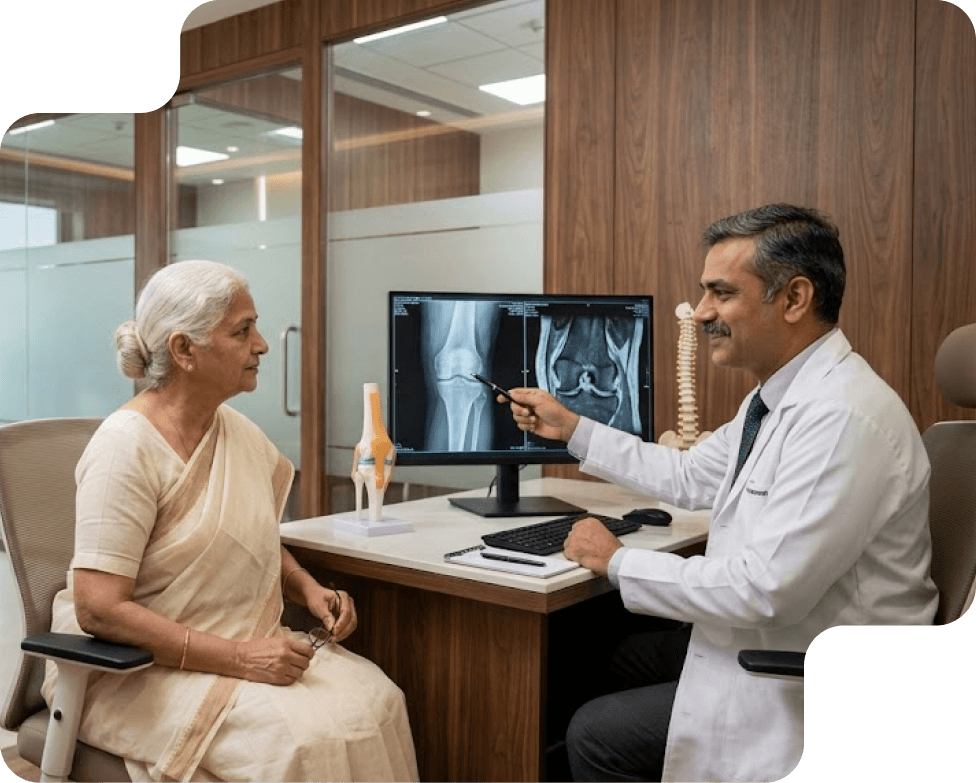
Understanding Paediatric Orthopaedics
Children's bones and joints are still growing, so orthopaedic conditions need age-specific assessment and treatment. Early diagnosis of growth or alignment problems helps ensure healthy long-term development.
Conditions We Treat
Clubfoot
A congenital condition where a baby's foot is turned inward and downward, treatable with early intervention.
- Noticed at birth or in early infancy
- Foot appears turned or twisted
- Difficulty fitting into regular footwear later
Developmental Dysplasia of the Hip
A condition where a baby's hip joint has not formed normally, affecting movement.
- Uneven leg length is noticed
- Hip clicking or limited movement
- Delayed walking or unusual gait
Growth Plate Injuries
Fractures or damage to the growing ends of a child's bones, needing careful management.
- Pain or swelling near a joint after injury
- Reduced movement following a fall
- Persistent pain during growth spurts
Scoliosis
An abnormal sideways curve of the spine that often develops during growth spurts.
- Uneven shoulders or waistline is noticed
- One shoulder blade appears more prominent
- Curve is noticed during a school screening
In-Toeing & Bow Legs
Common childhood alignment variations in the legs and feet, most of which resolve with growth.
- Child trips frequently while walking
- Legs appear noticeably bowed or knock-kneed
- Parents are concerned about walking pattern
Paediatric Fractures
Bone fractures in children, which often heal differently from adult fractures due to ongoing growth.
- Pain or swelling after a fall or injury
- Child refuses to use the affected limb
- Visible deformity of an arm or leg
Recovery & Rehabilitation
From diagnosis to healthy growth, paediatric orthopaedic care progresses through clear stages.
Assessment
Growth-Focused Evaluation
Clinical examination and imaging assess bone alignment, growth plates, and joint development appropriate to the child's age.
Treatment
Age-Appropriate Care
Bracing, casting, or minimally invasive correction is chosen to suit the growing skeleton and specific condition.
Recovery
Guided Growth Monitoring
Regular follow-up tracks the child's growth and movement to ensure treatment is progressing as expected.
Follow-up
Healthy Development
Ongoing review continues through childhood to confirm normal alignment and function as the child grows.
Paediatric Orthopaedics questions
Get answers about children's bone and joint conditions, treatment, and growth monitoring.
Yes, most cases are successfully corrected with the Ponseti method — gentle weekly casting followed by bracing — without major surgery.
You may benefit from a paediatric orthopaedic review if:
- Your child's walking pattern looks unusual
- A limb appears bowed, turned, or uneven
- Pain or swelling follows a fall or injury
- A growth or posture concern was flagged at school
- You have questions about normal development
Most childhood variations resolve with growth
Many alignment differences correct naturally as a child grows. Treatment is recommended only when assessment shows a condition that needs guided correction.
Need help deciding? Our Care Guide can help you understand what is normal and what needs review.
Emergency care when every minute matters.
Round-the-clock emergency, trauma and critical care teams, ready ambulances and rapid response across our Patna and Begusarai units.
24×7 Emergency
Always-staffed emergency rooms in Patna & Begusarai.
Ambulance
Rapid ambulance dispatch, 24/7 emergency support.
ICU & Critical Care
Advanced life support and intensive care.
Cardiac Emergency
Heart-attack and chest-pain response pathway.
Stroke / Neuro
Time-critical stroke and neuro emergency care.
Trauma & Accident
Trauma team for accident and injury cases.